What Causes Eating Disorders?

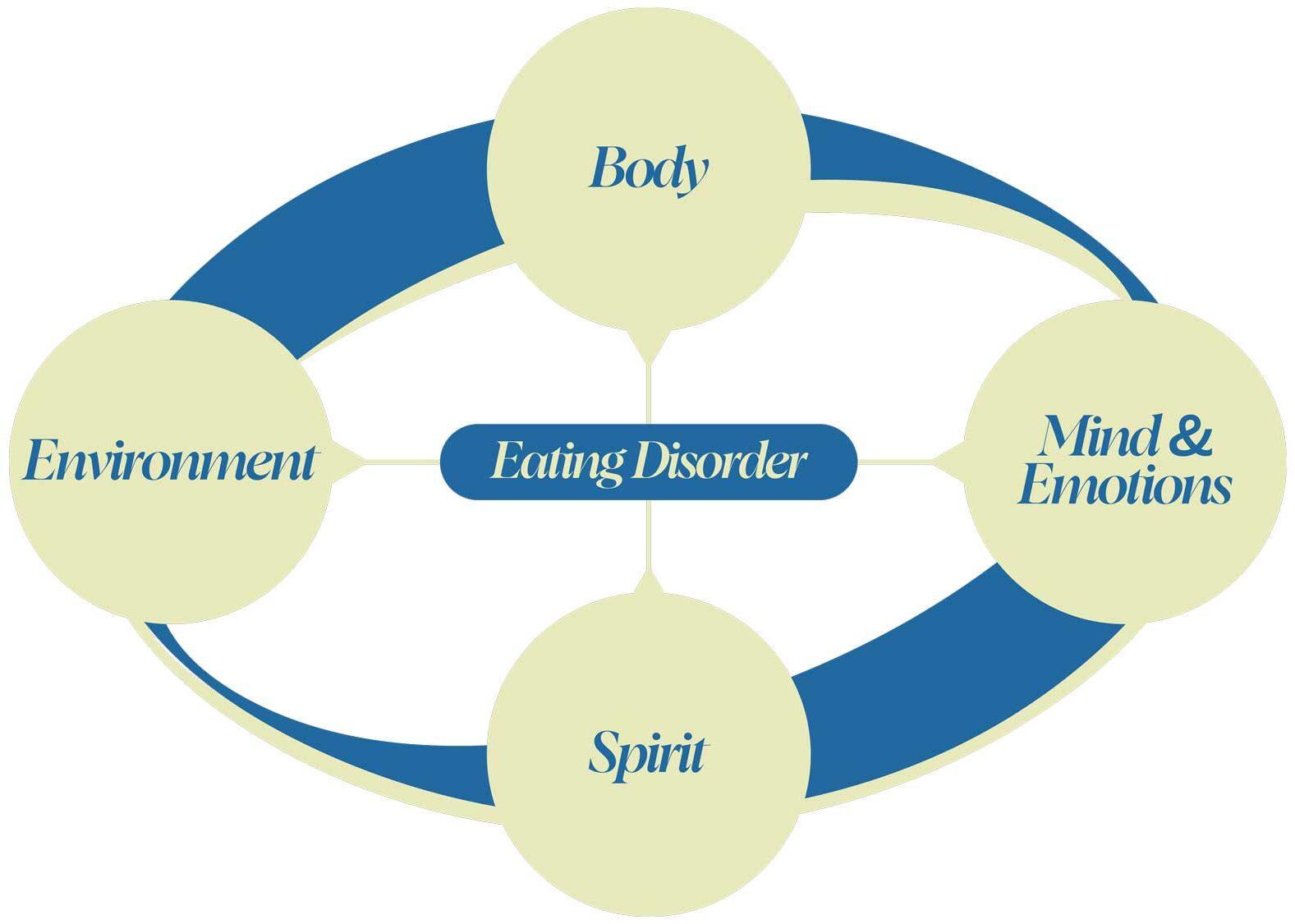
Eating disorders develop due to the interaction of any number of physical, emotional, psychological, social, cultural and/or spiritual factors. Each person’s story is different – there is no ‘one size fits all’ approach. However, a variety of factors can increase the risk of developing an eating disorder. Select each “+” icon on the diagram below to see some examples.

Some people who have experienced eating disorders explain that these factors combined to create a sense that they were not ‘enough’ – ‘good enough’ or ‘safe enough’. The eating disorder (sometimes subconsciously) promised to provide a sense of goodness, control and safety amidst uncertainty and shame. Yet, it ultimately failed to deliver.

‘I felt intense shame all the time. These narratives of, like, “I’m not enough, I’m a bad child, everything’s my fault”. And so, I already felt a lot of shame. And so then I would engage in this eating behaviour as a way of, like, trying to feel a sense of control over these emotions that felt very frightening. But…in the end…it was sort of like, reaffirming, “Yes, you are bad, you are disgusting, you are terrible.”

Warning Signs

The NEDC offers helpful information about some early warning signs of eating disorders. It is important not to ignore these, but instead to seek appropriate support.

  1. Bonaccorsi V, Romeo VM. Psychological and Psychiatric Consequences of Prolonged Fasting: Neurobiological, Clinical, and Therapeutic Perspectives. Nutrients [Internet]. 2026; 18(1):[60 p.].
  2. Barakat S, McLean SA, Bryant E, et al. Risk factors for eating disorders: findings from a rapid review. Journal of Eating Disorders. 2023;11(1):8. doi: 10.1186/s40337-022-00717-4.
  3. Nickel K, Maier S, Endres D, et al. Systematic Review: Overlap Between Eating, Autism Spectrum, and Attention-Deficit/Hyperactivity Disorder. Frontiers in Psychiatry. 2019;Volume 10 – 2019.
  4. Pehlivan MJ, Okada M, Miskovic-Wheatley J, et al. Eating disorder risk among Australian youth starting a diet in the community. Appetite. 2024;203:107685. doi: 10.1016/j.appet.2024.107685.
  5. Abdoli M, Schiechtl E, Rosato MS, et al. Body image, self-esteem, emotion regulation, and eating disorders in adults: a systematic review. (2194-1327 (Electronic)).
  6. Akrawi D, Bartrop R, Potter U, et al. Religiosity, spirituality in relation to disordered eating and body image concerns: a systematic review. Journal of Eating Disorders. 2015;3(1):29. doi: 10.1186/s40337-015-0064-0.
  7. Exline JJ, Homolka SJ, Harriott VA. Divine struggles: links with body image concerns, binging, and compensatory behaviours around eating. Mental Health, Religion & Culture. 2016;19(1):8-22. doi: 10.1080/13674676.2015.1087977.
  8. Quiles Marcos Y, Quiles Sebastián MJ, Pamies Aubalat L et al. Peer and family influence in eating disorders: a meta-analysis. European Psychiatry. 2013;28(4):199-206. doi: 0.1016/j.eurpsy.2012.03.005

Body (Biological):

  • Genetics²
  • Female gender²
  • Dieting²
  • Childhood weight²
  • Autoimmune disease²
  • Gut microbiome problems²
  • Early puberty²

Mind (Psychological):

  • Anxiety/Depression¹
  • Obsessive/perfectionistic temperament (restricted intake)²
  • Impulsive temperament (binge eating)²
  • Low self-esteem⁵
  • Emotional regulation difficulties⁵
  • Other mental health conditions, including autism spectrum disorder³, obsessive compulsive disorder (restricted intake)², bipolar disorder (binge eating)², borderline personality disorder (binge eating)² and attention-deficit hyperactivity disorder (binge eating)³

Spirit (Religious/Spiritual):

  • Participating in religion due to social expectations or to gain personal benefits (‘extrinsic religiosity’⁶)
  • Struggling with beliefs about or relationship with God⁷

Environment (Social):

  • Trauma/abuse²
  • Appearance-related teasing²
  • Family pressure related to weight or eating²
  • Peer influence8
  • Exposure to the ‘thin ideal’²
  • Participation in elite sports²
  • High educational achievement (restricted intake)²
  • Food insecurity (binge eating)²