Just as having a Christian faith can influence eating disorder journeys, an eating disorder can also influence Christian faith journeys. This perhaps isn’t surprising, as eating disorders are often deeply and intensely distressing, and even life-altering, experiences. This can be true not just for the person with the eating disorder, but also for those close to them.
Most obviously, the physical and psychological effects of an eating disorder can affect a person’s ability to participate in religious activities. Some people stop attending church because of physical effects of an eating disorder, the intensity of treatment, or concerns about eating in public. Even taking Holy Communion can be difficult for some people experiencing eating disorders. For some people, eating disorder thoughts become so consuming that they begin to care less about other things, including their faith.
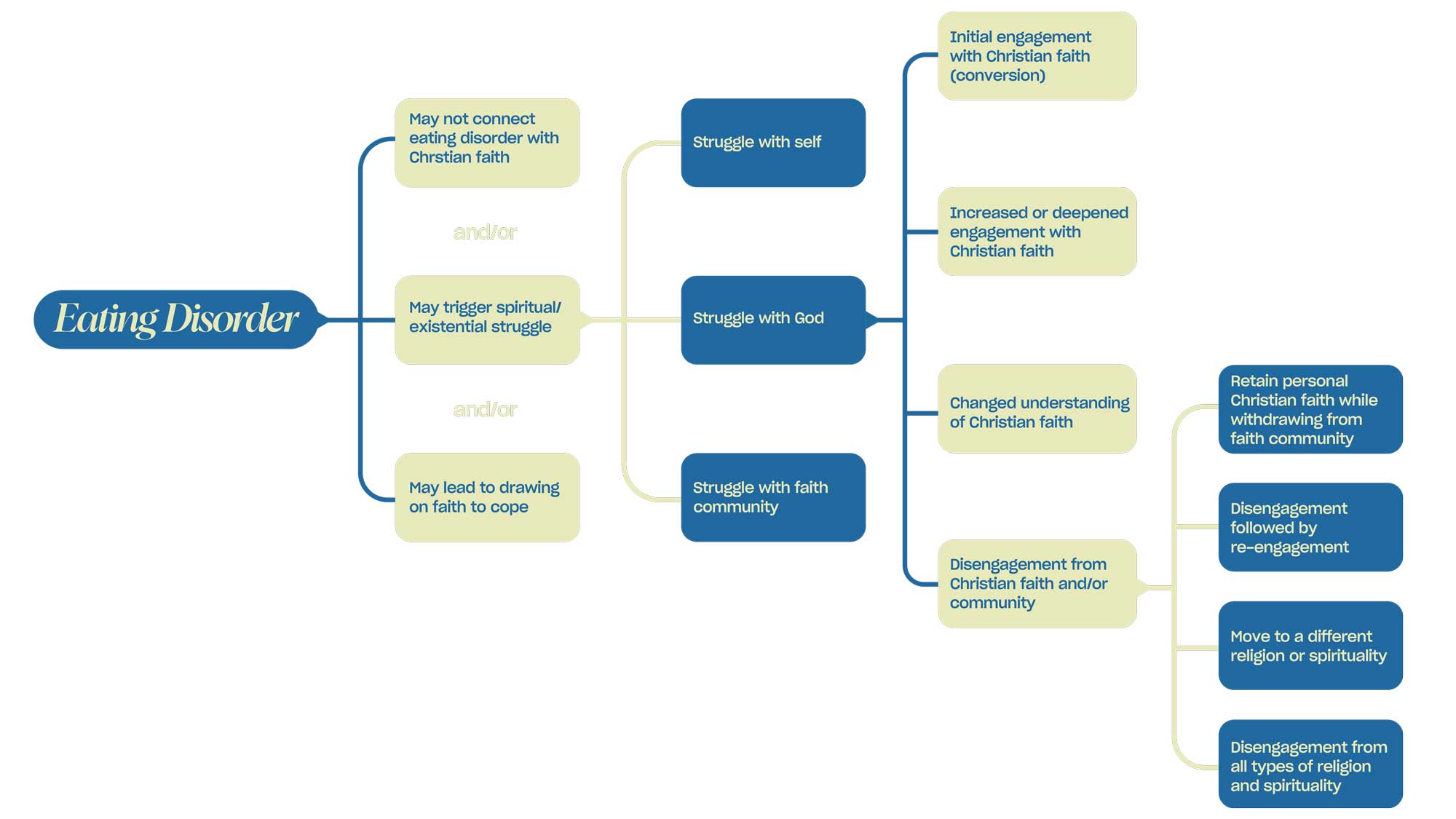
Less obviously, the existential distress that often accompanies eating disorders can influence spiritual journeys (existential distress refers to suffering related to concerns about things such as life’s meaning, past choices, isolation and mortality).¹ This can look very different for different people. Some experience spiritual struggle. Some draw on their faith to cope. Some do both. For some people, this leads to deepened faith. For others, their experience or understanding of faith or spirituality changes. Others disengage from all types of religion and spirituality.
The diagram below illustrates these types of journeys. You can click on the + icons to learn more about each aspect. We would like to acknowledge that this approach draws on the framework of spirituality and spiritual coping developed by Professor Kenneth Pargament.²
If you are journeying through spiritual or existential struggle during an eating disorder, you might like to visit the ‘I’m struggling with eating’ page for further information and support. If you are walking alongside someone with an eating disorder, and struggling yourself or wondering how to support them through their spiritual struggle, the ‘I’m Supporting a Friend or Family Member’, ‘I Know Someone at Church who Struggles with Eating’ or ‘I’m a Christian leader’ pages may be helpful.
The stress of experiencing or supporting someone through an eating disorder can challenge a person’s religious and spiritual framework. Or it might prompt them to begin thinking about religious and spiritual issues. This can lead to spiritual and existential struggle. These struggles may relate to self, God, and/or others.
Some Christians who experience or support someone through an eating disorder draw on their faith to help them cope. Depending on the specific way in which they use their faith to cope, this may be helpful and/or unhelpful. For example, people might find meaning in their eating disorder by trusting that God will use their suffering for a purpose (which may be comforting), or by explaining the eating disorder as God’s punishment for their sin (which may exacerbate spiritual struggle).
Christians experiencing eating disorders may struggle with a sense of religious guilt and shame for having the disorder. Similarly, parents often struggle with whether they have contributed to their child developing an eating disorder.
‘Within…Christian faith…your body is a temple and…looking after it…and it being, like, God’s house….So, I had that in my mind and…I felt like I was at war with myself…I think it did actually make it harder. I just feel that I had a lot of internal struggle around all the different things.’
Some Christians view the eating disorder as a spiritual battle, and their sense of guilt as one aspect of this.
‘There was that battle constantly going on. And then, you know, obviously…the enemy comes in and wants to make it feel like it’s you. Like, you’re the problem, it’s because you are not doing enough or are not good enough or whatever. So, there was that constant battle.’
Some also struggle with doubts about their faith, feeling unsettled and no longer sure of what they believe. This can cause existential distress.
‘[It] was a big faith wrestle for me, because I was like, “Is this real? Is God real? I’m in so much pain right now. Does He have anything to say about that?”’
Some people experiencing an eating disorder feel angry with, or punished or abandoned by God, or wonder if He loves them.
‘I…hated God amongst [the eating disorder] as well…During those years of giving up the bulimia…I would wander the street at night for hours, mostly screaming at God.’
Some Christians feel hurt or abandoned by their church or faith community during their eating disorder. They might also struggle with no longer being sure that they believe what they feel that their faith community expects or wants them to believe.
‘We kind of got rejected in many ways by our whole church community…I kind of didn’t have as much connection with our new church…We also weren’t attending as much, and I think my family was…a bit fearful we’d run into the same rejection again.’
Some people decide to become Christian during an eating disorder. Christian faith can offer a source of value, love, hope and meaning. This can offer them comfort amidst distress and support recovery.
‘I closed my eyes and I said, “God, if you’re real, show me.” And then in that instant the Holy Spirit just filled me and I just cried. I sobbed. I couldn’t stop. It just all came out and it just felt like God was washing me clean…It was just so much healing, but hurt as well of what I had gone through on my own. So that was how I met Jesus.’
Some people describe that the struggle of having or supporting someone with an eating disorder causes them to draw more deeply on, and grow in, their Christian faith.
‘I wouldn’t be where I am today if [God] just took [the eating disorder] from me. Like, I don’t think I would’ve learned as much. I wouldn’t have been strengthened as much. My faith wouldn’t have been as…deep as it was. I wouldn’t have had to rely on Him so much and, like, cry out to Him so much, and learn about Him and just be so desperate for Him…And that’s a good thing.’
Spiritual struggle during an eating disorder changes the way that some people understand Christian faith. For example, some who grew up believing that being a Christian is about ‘keeping the rules’ describe a deepened understanding of God’s grace, or unconditional love and favour. Others changed the way that they approach and interpret the Bible.
‘I did quite a lot of reading…around some of the deconstruction type stuff, and starting to kind of…disconnect from it has to be a particular way of interpreting the Bible, to being able to see that actually there are different interpretations, and how did this translate to everyday practice.’
As a result of the spiritual struggle triggered by an eating disorder, some people disengage from Christian community, and sometimes from Christian faith.
Some people, particularly those who have experienced significant struggles with their faith community, stop attending church or engaging with a faith community, while holding onto a personal Christian faith. Some feel that this is necessary to protect them from environments that may exacerbate their eating disorder, or from re-experiencing spiritual abuse or trauma.
‘These days my attendance at a church is fairly hit and miss…partly just even time…but also just being a little bit cautious in going back into environments because some of the ones I’ve been in have been quite high control in that way…Whereas…I can’t quite get away from it being a key part of life still…There is still very much a strong draw to some of the real Christian, I guess, core things of, like, your love of neighbour and looking out for those who are oppressed and marginalised, and I guess, what you see embodied in Jesus.’
Some people disengage from Christian faith and/or faith communities for a time, before re-engaging. For some, this is because of the steady love of the Christians around them.
‘[I thought that] there’s no way they can keep loving me. And then they loved me continuously. And then it was like, how does God love me? Like, I’m a wreck…So, then I started just a whole 180. I went back to God.’
Some people may move away from Christianity and engage with a different understanding of religion or spirituality. For example, they may identify with a more universal spirituality, while questioning Christian beliefs.
‘At the moment…I feel I’m much more open-minded. I’m a lot more gentle on myself with trying to figure all this out. And like I said, perhaps it’s not that I ever do fit a box…It’s not that I’m anti-Christian…but it just doesn’t…quite feel right in me anymore…It’s a bit scary not knowing fully what I believe, but I do believe in a higher power or God or universe where I’m like, why do we need the same name for things?’
Some people who initially identified with Christianity disengage from all types of religion and spirituality during their eating disorder and adopt an agnostic or atheistic worldview.
‘I’d really thought about – I just had a lot of feelings around [Christianity] and thought a lot about how I felt, and I didn’t feel like that was right for me anymore.’