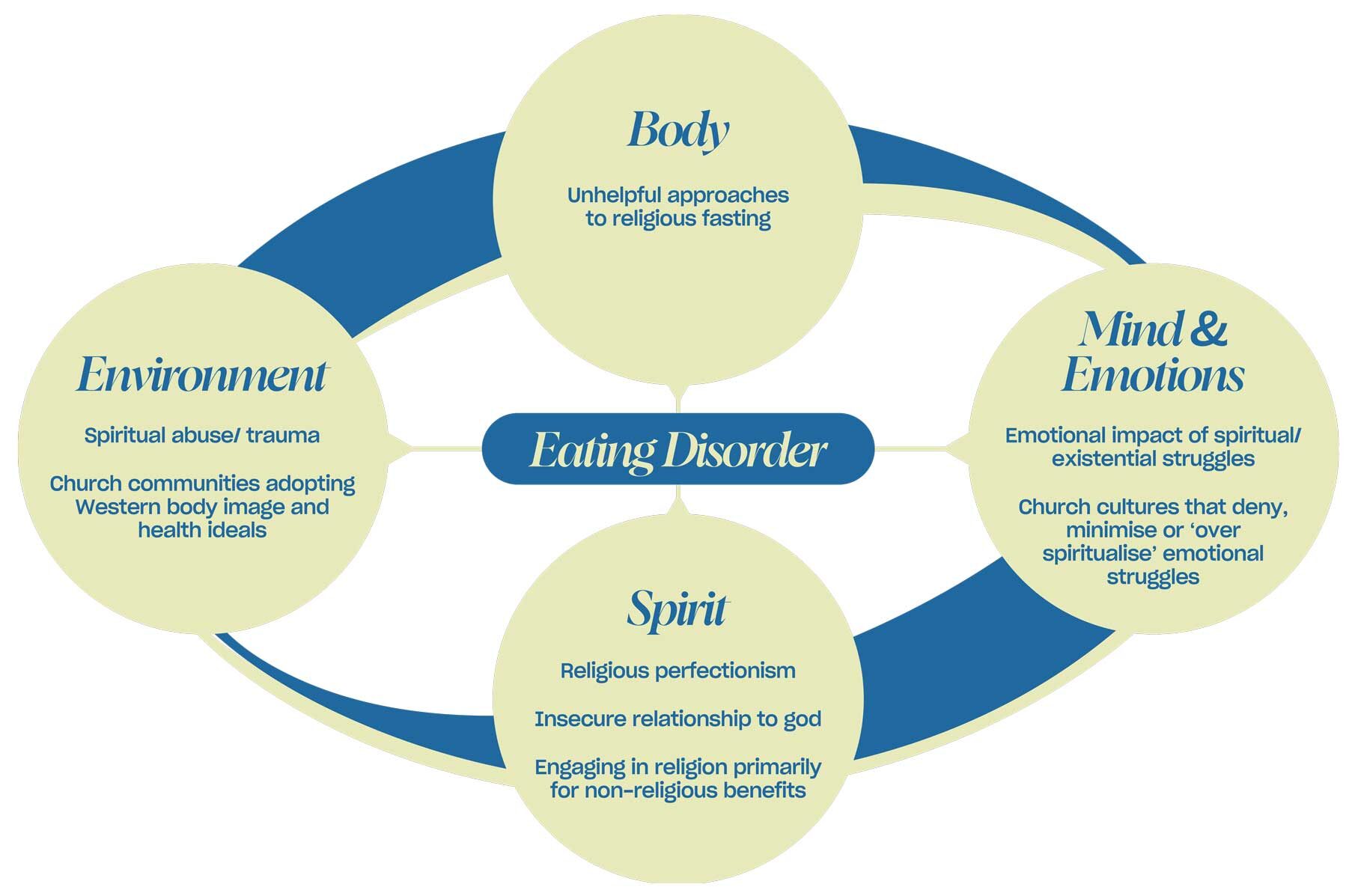
This diagram shows some aspects of Christian experience that research suggests may exacerbate eating disorders. Click on the + icons to learn more about each one.
‘From a spiritual discipline standpoint there was a strong emphasis [at my church] for a number of years on fasting as a spiritual discipline…There was a lot of people who would do pretty much complete fasts…And so that was…lauded…perceived as a more faithful person…There was this real…sense of restrict and restraint is a positive thing…Even just from a biology standpoint, what that can kick off in terms of eating disorder cognitions and processes and stuff…The interplay there. But I also think it meant that it took a lot longer for [my eating disorder] to get picked up, because there were so many added layers of being able to justify the why. “Oh, I’m just not eating that because I’m fasting from that for a time,” or, you know, like that kind of thing. And so you could kind of get away with it longer.’
Spiritual and existential struggles can cause emotional distress (‘existential’ struggles relate to things like life’s meaning, past choices, isolation and mortality).¹³ An eating disorder may offer a false sense of stability or comfort in this context.
‘I didn’t have an anchor, so the ED became that anchor…I didn’t have a specific faith anymore or…groundedness to…talk to God and rely on Him…So…the ED was like, “Yes, I will ground you and make you feel better and look after you and keep you safe.”’
Some people have been hurt by church cultures that deny, minimise or ‘over-spiritualise’ mental health and emotional struggles. This might look like:
‘And the church was really just like, you know, if you are a good enough Christian, you’ll be cured. Or if you believe in it enough…if you pray enough, you’ll be cured. So, it really was in that mindset that…if you have an illness and you’re not being cured, it is like, “Oh, am I not a good enough Christian?” Like, “I’m not praying hard enough,” or “I’m praying, but I don’t believe in it,” you know? So that’s why I’m being punished or whatever.’
People who have experienced these types of situations have offered some thoughts about how churches might create safe faith communities for people experiencing mental health struggles.
Perfectionists strive to achieve unrealistically high (‘perfect’) standards.³ They harshly criticise themselves when they do not meet these standards. Perfectionism increases the risk of developing some types of eating disorders.
For some Christians, perfectionism develops religious overtones. They might be told or sense that God demands that they achieve perfection, and then feel deep guilt and shame when they are unable to do so. Religious perfectionism may add to the sense of not being ‘good enough’ that can drive eating disorders. People might also begin to relate God’s standard of perfection to cultural health and body image ideals, consciously or subconsciously believing that God wants them to achieve the ‘thin ideal’ (or whatever body image is preferred in their cultural context).
‘From my experience of being in treatment there were a lot of Christians…with anorexia. I think it is that striving, that harshness on yourself and striving to be better. Having a real awareness of your sin and not liking yourself for it, maybe all of those things. There was one girl that said, “You talk about core beliefs.” Hers was she was evil…You can get the wrong ideas from your faith…as well.’
For some thoughts on navigating religious perfectionism in eating disorders, visit the ‘I’m struggling with eating’ section of this website.
We develop patterns of relating to others based upon early life experiences. These can affect how we relate to God. People who view God as primarily judgemental, punishing or distant are more likely to experience an eating disorder.⁴⁻⁵ They may avoid relating to God. Or they might feel very anxious, worrying that God will reject, punish or abandon them.⁶⁻⁹
‘Part of my ingrained Christian beliefs is…the fear [of God’s judgement] embedded in you as a child…I lean heavily toward the judgemental side [of God’s nature]…I have a lot of grace for other people. I have only judgement for myself…There was too much of the judgemental side in my early life, maybe? Definitely I don’t think I was aware of experiencing grace until much later.’
If you feel this way, the ‘I’m struggling with eating’ section of this website offers some thoughts that you might find helpful.
Experiences of abuse and trauma increase the risk of developing an eating disorder. Religious and spiritual abuse is under-recognised. This has been defined as “a form of psychological abuse characterised by a systematic pattern of coercive and controlling behaviour in a religious context or with a religious rationale”.10 It has profound and far-reaching effects.
Christian denominations have ‘safe church’ initiatives that offer resources to help address abuse within church contexts. There are also some thoughts about how churches might create safe faith communities here. If you have experienced spiritual trauma and abuse, please reach out to someone safe who is appropriately trained in this area, such as a mental healthcare professional with relevant expertise, for help and support.
Food, health and body image ideals permeate Western culture. The ‘ideal body’ is often portrayed as thin; or as lean, fit and muscular.¹¹⁻¹² An entire industry markets products that promise to achieve this ideal, like diets, ‘clean eating’ regimes, supplements and fitness plans. Christians are not immune to this and may consciously or unconsciously absorb these cultural ideals. When these are linked to Christian care for the body, it gives them additional moral weight.
‘Your appearance is the outward showing that you’re…a good person, if you’re not overweight. If you’re fit. If you eat healthy food. You know that judgment around food choices for me is very linked to…the only way you can be good Christian if is if you have a perfect life, and nothing ever goes wrong…All your ducks in a row, you know, you’re financially stable, you’re emotionally stable.’
This is an insidious issue and often difficult for people who have not had experience with eating disorders to recognise. We have offered some suggestions that faith communities may want to consider related to this area.