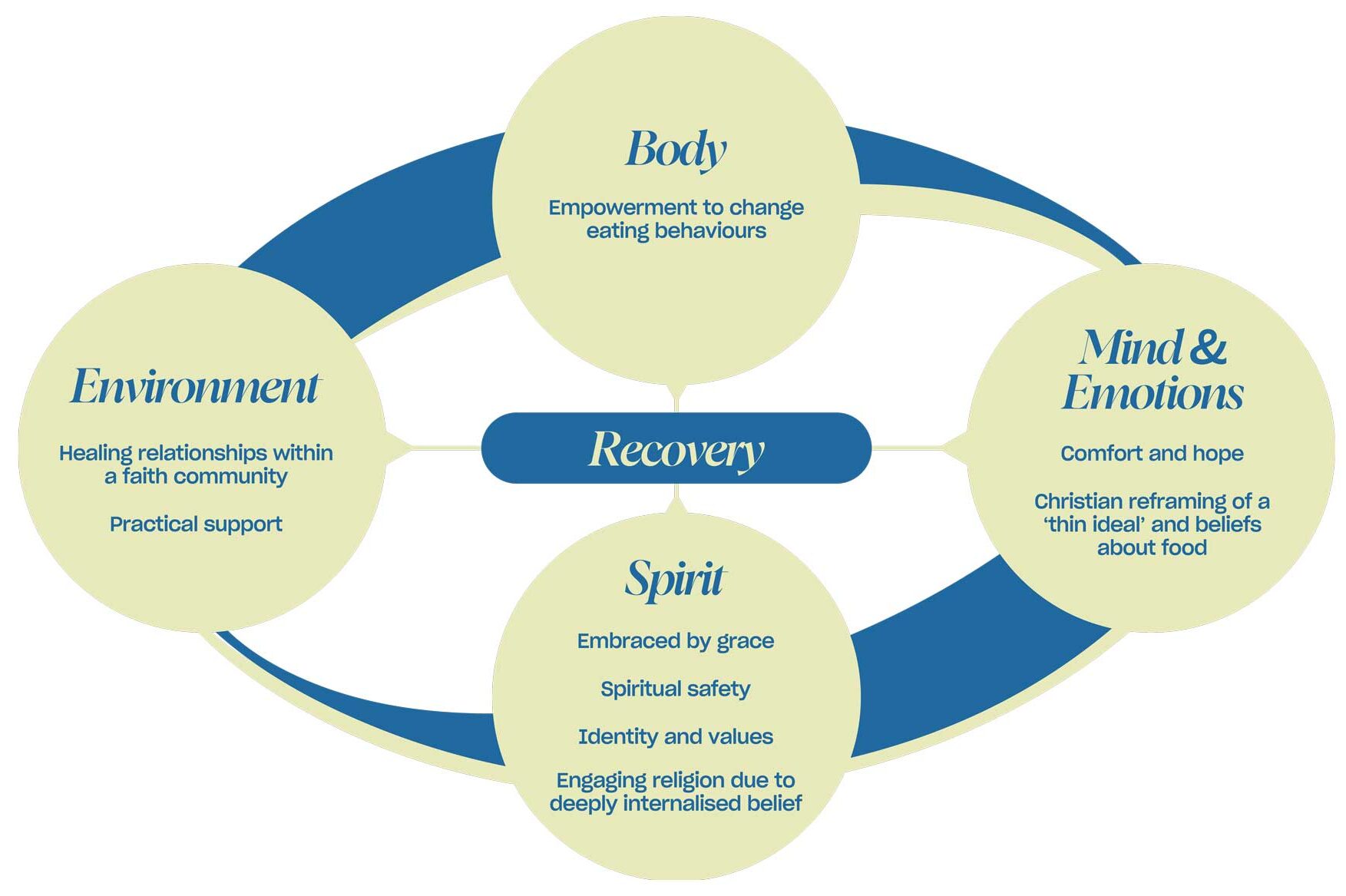
Eating disorders have many significant effects. These can include affects on a person’s body, mind, relationships and spirit. Select the + icons on the diagram below to see some examples.
‘With the eating disorder you feel compelled to…hide your food or eat the least amount when no nurse is watching…but just knowing that God was always there…helped calm the eating disorder down a little bit…I guess I just felt His presence…like a light…a good presence, rather than the presence of the eating disorder is quite tormenting and controlling.’
Christian faith can provide a deep source of comfort and hope for people experiencing eating disorders and their loved ones. This could include hope and confidence that God would heal the eating disorder, and/or that God would bring good from it regardless of the outcome.
‘[God’s] going to create meaning out of what we’re going through. And somehow, some way, it is making me more like Jesus and it’s for my good. And I think if I didn’t have that, I couldn’t do it.’
Sound Christian theology can help to reframe eating disorder thoughts about food and bodies. Viewing their body as God’s good creation, regardless of its size or appearance, can help people to accept, trust and care for it. Similarly, understanding that all foods are created by God helps some people to challenge their belief that some foods are ‘bad’.
‘Knowing…God has provided us with all this food…it’s literally our fuel and God has provided us that fuel…I think that has helped me to be a bit more flexible as well…I used to have my fear foods…But knowing these are natural foods that humans have lived off…for 100s, 1000s of years, you know? God has, provided that for us. Like, they’re not inherently bad.’
God’s grace, or unmerited love and favour, is perhaps one of the most deeply healing gifts that Christian faith can offer to those experiencing eating disorders. Christians who had experienced or recovered from eating disorders often described that they struggled to internalise God’s grace. Yet, as they grew in their experience of grace, a knowledge of God’s unconditional love spoke to their sense of not being ‘enough.’ This could alleviate perfectionism.
‘When I really get that grasp of grace, it’s like it doesn’t…matter what’s gone before or ahead. You know that you’re truly loved, and you can truly trust that everything is in His hands, you know…and what Jesus has done for us.’
For some Christians with eating disorders, God provides a sense of security.¹ This contrasts with, and can negate the need for, the eating disorder’s false promises of safety.
‘The main [helpful Scripture] that I remember now is, “I’ll never leave you nor forsake you.” Because I think that through my life lots of people have left me…and have forsaken me when I needed help the most…Lots of Psalms where…I feel like I had…been…hidden in God. You know, He was my safe place, and He would hide me.’
A sense of personal worthlessness is common in eating disorders. Aspects of Christian teaching offer resources to help restore a sense of worth. Examples include themes related to all people being made in God’s image, and Christians’ identity in Christ.
‘My worth and my value wasn’t based on my body image, it wasn’t based on my weight, it wasn’t based even on my performance or my academic ability or anything like that. It was all because of how [God] saw me and how He created me.’
Studies suggest that people who engage in religion due to having deeply internalised religious beliefs are less likely to experience eating disorders.¹ However, this doesn’t mean that people with deeply internalised religious beliefs don’t get eating disorders. They can, and some do, so it’s important not to assume that having an eating disorder implies that someone doesn’t have a deep faith.
Safe, loving faith community relationships can provide deep comfort to people experiencing eating disorders and their loved ones. Non-judgemental listening, empathy and support, without always trying to ‘fix the problem’ is often deeply valued. Supportive faith communities can also provide a context where people feel safe to risk eating in social settings, though they should not be pressured by the community to do this.
‘I’m in this really safe environment [at my church small group] with people who really care about me, and…if anything [emotion] spilled out because I was too overwhelmed [by eating], they wouldn’t be weird about it.’
Faith communities can also provide valuable practical support to people experiencing eating disorders and those close to them. Helpful support will differ depending on the person, but could include things like helping to arrange medical appointments, assisting with transport, providing family meals, visiting someone in hospital, or simply offering to pray. For more guidance on how you might approach this, see I Know Someone at Church who Struggles with Eating.
‘[The church] really wrapped around my family. They brought dinner twice a week…They took my younger [child] out…The pastor really supported my husband…they were amazing.’